

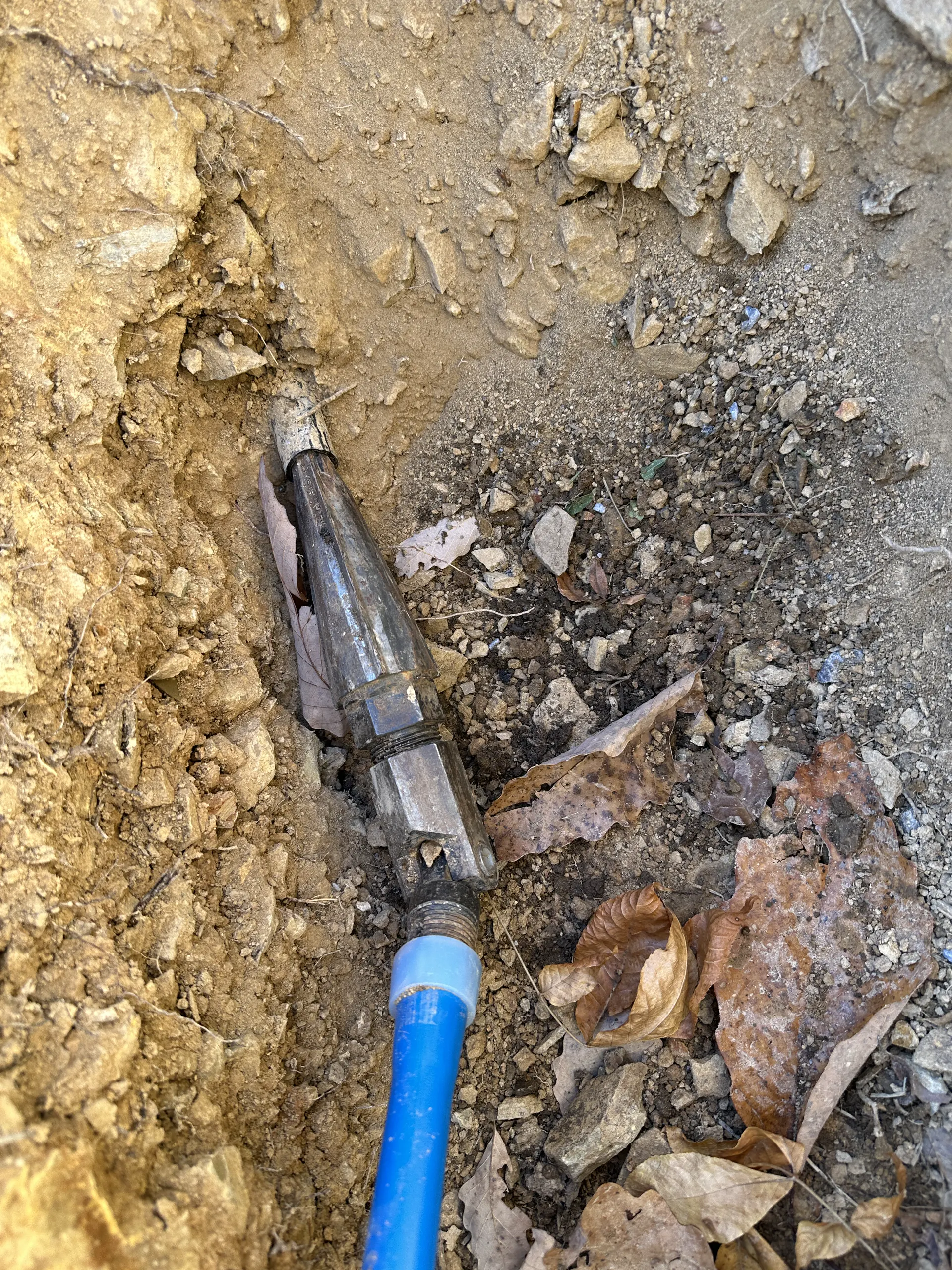
New Pipe Setup Before the Pull
The new water service line is connected to the pulling equipment and prepared to follow the existing underground route.
When site conditions allow, pipe bursting can replace an underground water line through smaller access points, reducing the amount of open trench needed across a yard, driveway, or landscaped area.
Trenchless water line replacement uses a planned underground route and limited access points instead of opening a continuous trench across the property. It can be a practical form of trenchless water line repair when a failed line needs replacement rather than a small spot repair.
Leak detection helps confirm where the problem is. When the line has failed beyond a targeted repair, pipe bursting may provide a water line replacement without digging up the entire yard. Read more plumbing tips before deciding what the property needs.
A Targeted Approach
Pipe bursting uses a replacement head to break apart the old underground water line while pulling a new line into the established path. It is designed to limit surface disruption compared with opening the full route.
A camera or line inspection may be part of the evaluation so the existing route and condition are understood before a method is chosen. Pipe bursting is not a one-size-fits-all answer; the old pipe, alignment, depth, nearby utilities, soil, connections, and equipment access all determine whether it is a responsible fit.
Pipe Bursting in Action
The replacement line is prepared and connected before it is pulled through the existing route. These field examples show the setup and the pull in progress.
The new water service line is connected to the pulling equipment and prepared to follow the existing underground route.
The new line is pulled into place through the old route, helping reduce surface disruption when the property is a suitable fit for pipe bursting.
Every pipe-bursting project is site-specific. The route, existing pipe, utilities, access, and soil conditions must be evaluated before this method is recommended.
The design and scope come from the actual property, not a standard package. We look at the route, access, existing line, and surrounding site conditions before recommending pipe bursting or traditional excavation.
A shallow line under grass is a different project from a deeper line under a concrete driveway, patio, or other hardscape.
The line’s length, size, and existing material affect the replacement plan, equipment, connections, and overall scope.
Gas, electric, sewer, and other underground utility crossings must be identified, and equipment needs safe entry and exit access.
Soil can affect excavation difficulty and may help explain how the original line deteriorated over time.
A fully collapsed, severely misaligned, or otherwise incompatible line may make traditional excavation the better choice. Inspection comes first.
Modern replacements are selected for the property and service requirements, with attention to durability, corrosion resistance, and mineral buildup.
Speed King inspects the line, confirms feasibility, and recommends the right method (trenchless or traditional) rather than defaulting to one approach.
No-dig water line replacement can reduce the amount of excavation needed when the route and site conditions are suitable. It is one option for underground water line replacement, not a promise that every property can avoid all digging.
Water service line work affects the property, the water supply, and the work that may need to be coordinated with local authorities. Speed King brings licensed, insured service and a site-specific plan to residential water line replacement instead of guessing from the surface.
Sevier County and the surrounding communities we serve have a permit and inspection process for water line replacement, and we contact the permitting authority on every job. Whether they require a formal permit, schedule an inspection, or determine that one is not required for your specific situation. That is their call to make. What we control is that we never skip the step.
Water line work coordinates with the applicable local water utility, depending on your location. Speed King handles the full permitting picture. You do not need to navigate it alone.
The Process
We identify the failed line and review leak evidence, pressure concerns, visible damage, and the existing service route.
We assess utilities, access points, pipe condition, alignment, site conditions, and whether pipe bursting is appropriate for the water-line route.
You receive a practical pipe bursting and trenchless water-line recommendation based on what the property actually requires.
The right goal is a dependable new water service line with the least reasonable disruption. We evaluate the route first so any pipe bursting plan matches the actual property conditions.
Many trenchless water line projects can be completed in a single day, while more complex routes may take a few days. The actual schedule depends on access, permitting, utility locations, site preparation, and whether pipe bursting is appropriate.
It can be appropriate for many older properties, but the existing pipe, route, connections, nearby utilities, soil, and equipment access must be evaluated first. If those conditions do not support pipe bursting, we will explain the more suitable approach.
Pipe depth and surface type are two of the biggest drivers, along with line length, size, material, utility crossings, soil conditions, access, existing pipe condition, permitting, and restoration. Contact us for a free, job-specific quote.
Permit and inspection requirements depend on the local authority and the specific work. Speed King contacts the permitting authority before the job starts and follows the process they establish for the property.
When the route and site conditions are suitable, pipe bursting can reduce the amount of open trench compared with digging the entire line. Entry and exit access points are still required, and the final recommendation depends on the actual property.
Speed King contacts the permitting authority on every job and coordinates with the local water utility, such as the Sevier County Utility District where applicable. We handle the permitting picture so the homeowner does not have to manage it alone.
One call covers it all: here's what else we do.
Leak Detection
Acoustic and tracer-gas methods for hidden water leaks.
Camera Inspection
Video pipe inspection to see exactly what's inside your lines.
Drain Cleaning
Professional drain cleaning for slow or completely blocked lines.
Water Heater Service
Water heater installation, replacement, and repair.
Local service areas: SeviervillePigeon ForgeGatlinburgJefferson CityMorristownNewportView all by county
Quick Answers
Direct answers to common questions about this service.
Pipe bursting replaces an underground water line through limited access points instead of opening a full-length trench across the property. The method depends on the existing pipe, route, soil, connections, and safe equipment access.
Often, but not always. A no-dig water line replacement may reduce excavation when the line path and site conditions are suitable, though entry and exit access points are still normally required.
No. Pipe bursting water line replacement depends on the condition and alignment of the old pipe, nearby utilities, fittings, access, and the replacement route. We evaluate the site before recommending the method.
Cost depends on line length, depth, pipe material, access, utility conflicts, connections, permits, and restoration needs. A site evaluation is necessary before giving an honest scope and price.
The schedule depends on the route, access points, permitting, utility locations, site preparation, and whether trenchless replacement is appropriate. Those conditions must be confirmed before a realistic timeline is given.
A pipe bursting evaluation may help when an underground residential water line crosses a yard, driveway, or landscaped area and the route, existing pipe, utilities, and access points support a trenchless replacement plan.
Tell us what you are seeing at the property. We will assess the problem and determine which replacement approach fits the site.