Three Fittings, One Supply Line: What Happens When a Plumber Grabs Whatever's Left on the Truck
Three different fitting types on one supply line. Only one of them was a connection we'd have made ourselves.
Three different fitting types on one supply line. That's what we found under a kitchen sink in a Pigeon Forge cabin, on a call that started out as a simple leak.
The leak was on the hot side. The cold side wasn't leaking at all. We fixed what was actually failing, and we're recommending the rest get replaced anyway. Here's why.
The Fittings We Found
Follow the red PEX from the slab to the valve and you cross three separate connections. A push-to-connect fitting ties it to the copper stub coming out of the floor. A crimp ring holds the elbow. A compression fitting lands it at the angle stop.
One of those three is fine. The crimp ring, done correctly, is exactly the kind of connection we'd use ourselves. It just happened to end up on a run with two fittings we wouldn't have chosen.
Why the Compression Fitting Won't Hold Up
Compression fittings are built for rigid pipe. Copper doesn't give under the ferrule's bite, so the seal holds. PEX does give. It's a polymer, and under sustained compression it slowly relaxes, a process called creep. The tight seal from day one isn't guaranteed two years out. That's not the fitting's fault. It's the wrong pipe for the job the fitting was designed to do.
Why We Don't Use Push-to-Connect, Full Stop
The push-to-connect fitting is the one we feel strongest about. Cut the pipe square, deburr it, push it past the depth mark, and the internal O-ring and stainless collet are rated to hold. Fine. But rated to hold and verified to hold aren't the same thing once that fitting disappears behind a wall or under a slab. Nobody checks it again without opening things back up.
We've spent more than twenty years in this trade working with methods that have earned their place: soldered copper, crimped and cinched PEX, threaded connections, ProPEX fittings. Push-to-connect never made that list. It's fast. It's cheap. It doesn't ask much of the person installing it. None of that is the same as reliable, and we don't use it, buried or exposed, ever.
The Cold Side
Same day. Same hands. Same materials. Same cabinet. The cold side just hasn't failed yet.
We can't tell you exactly when it will, or whether it'll go the same way the hot side did. Creep and fitting quality vary too much to promise that. What we can tell you is that once one half of a matched pair fails, we stop calling the other half low-risk just because it's still dry. That's why we're recommending it get replaced too, not because it's leaking, but because it was built the same way something that just did.
Every plumber who's ever touched this line most likely was licensed to be there. Whether the work was built to last another twenty years or just long enough to pass inspection was never going to show up on the permit. It shows up in the findings.
Case Photos & Videos
Review the visual evidence from this project.
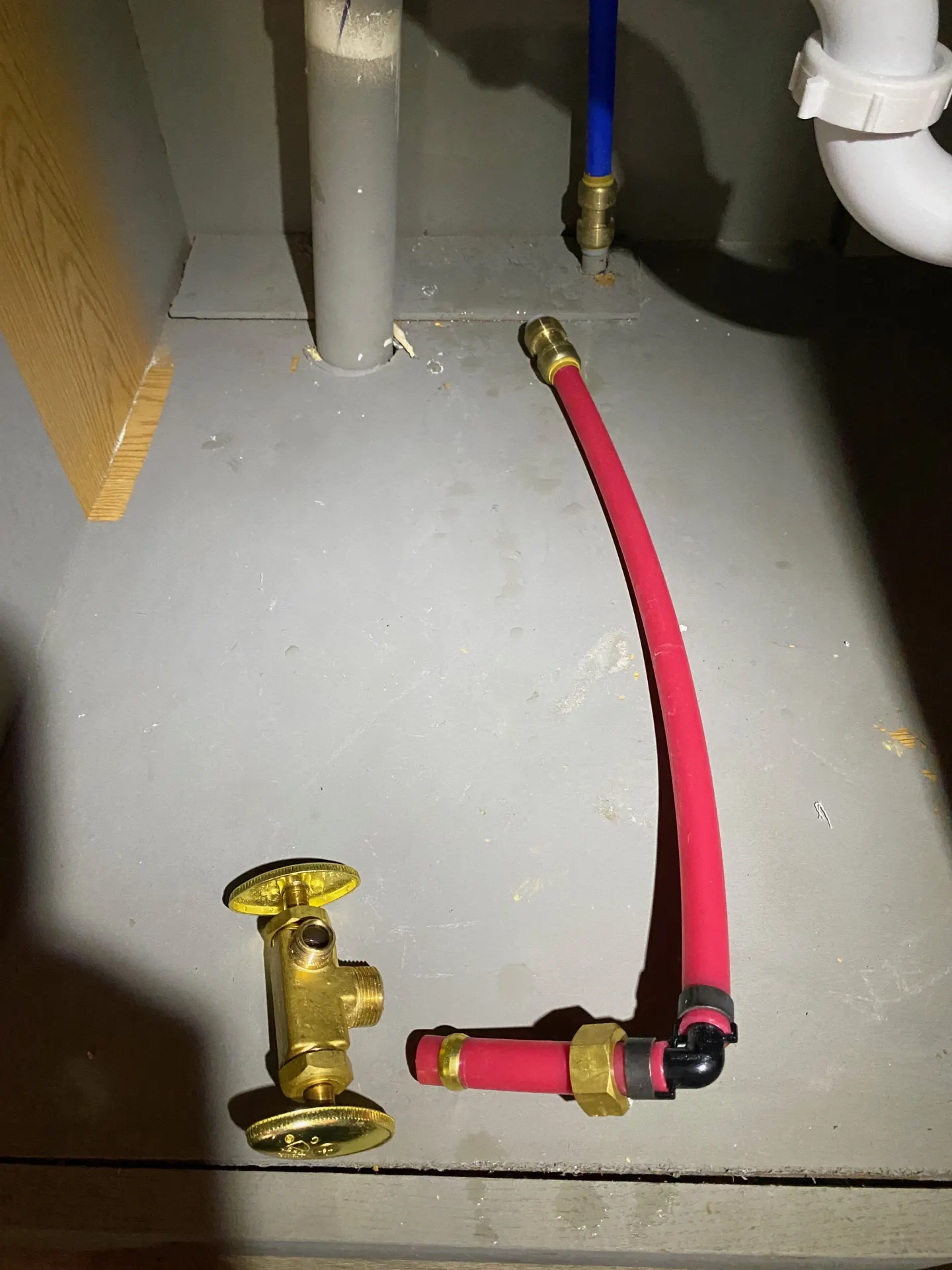
![Repaired hot side supply line under a kitchen sink cabinet, reconnected with [soldered copper / crimped PEX] fittings.](/content-media/20260831-164329-5f7b6693d3b5.webp)