A Conservative 86,400-Gallon Estimate: How We Found the Leak Outside the Garage
The owner reported that this water leak had likely been running for about two months. Another plumber believed it was probably beneath the concrete garage floor. Before any concrete was opened, Speed King located the actual failure outdoors and completed the repair in under four hours from the first call through finished work. A controlled flow test supports a conservative estimate of 86,400 gallons lost, with no water ever surfacing above the leak.
The costly assumption
The property owner reported an unexplained water loss that had likely continued for approximately two months. That timeframe is the owner’s estimate; it was not verified against a water bill or another outside source. Another plumber had already suggested that the leak was most likely beneath the concrete garage floor.
That was an expensive assumption. Opening a garage slab can mean concrete demolition, excavation inside the structure, dust, restoration work, and days of disruption. If the assumed location was wrong, all of that damage could happen without exposing the leak.
The owner was understandably hesitant to authorize destructive work based on a probability. We assured her that our job was to locate the leak before deciding where to open the property.
What we found
The leak was not beneath the garage floor.
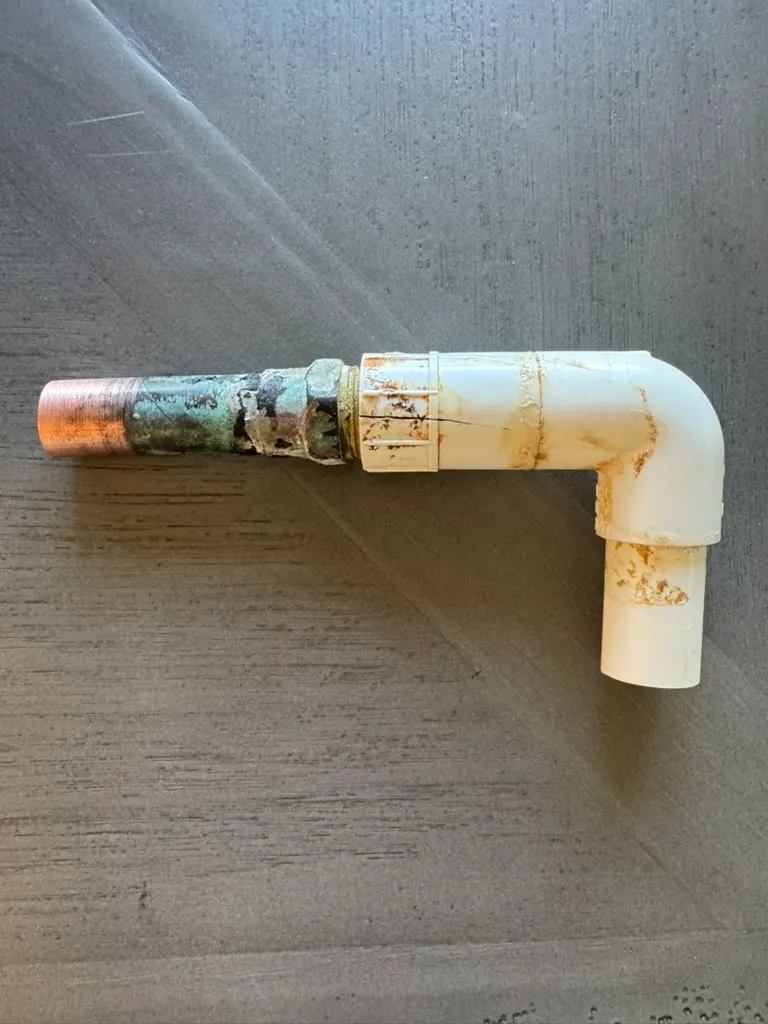
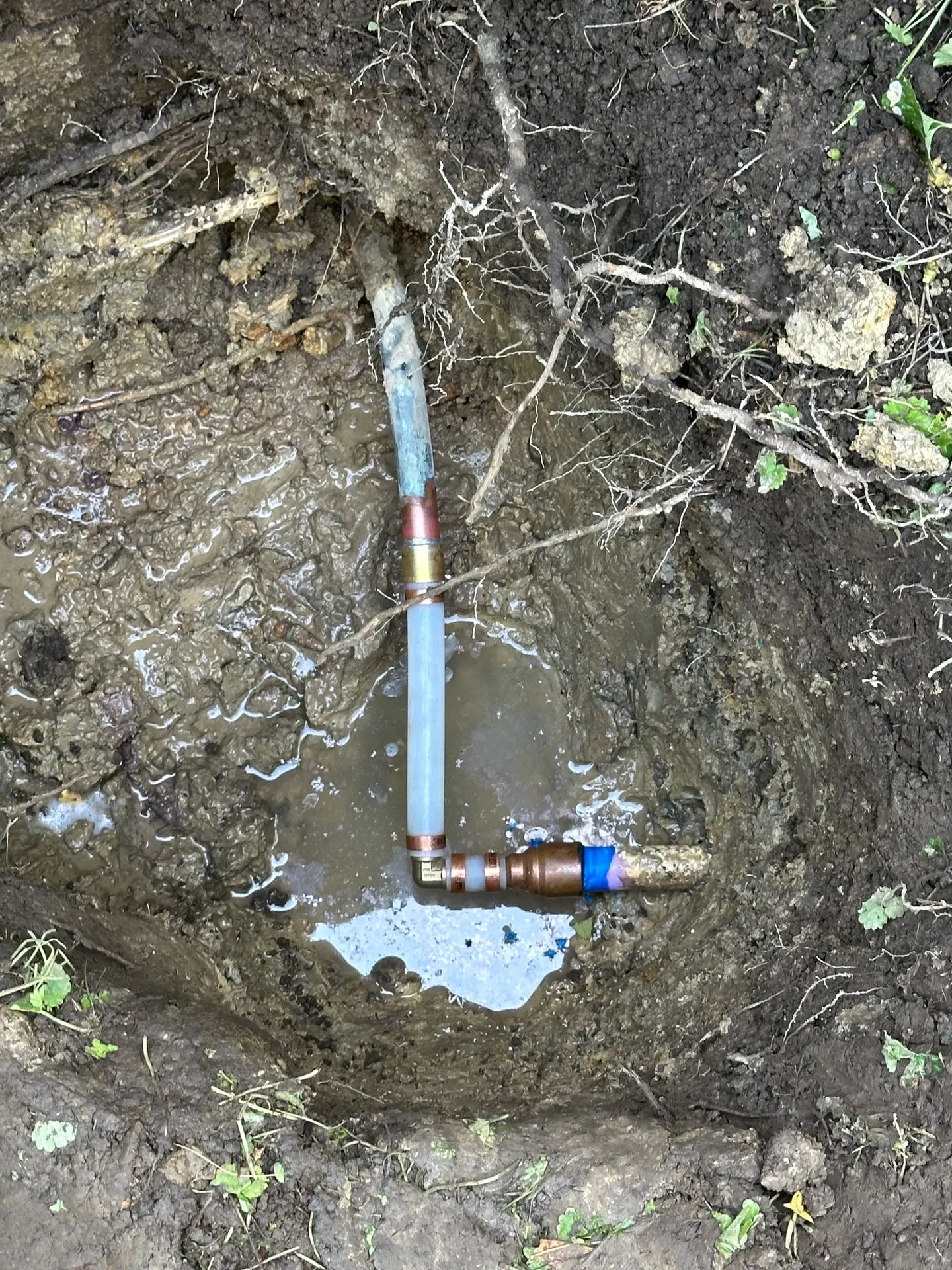
Using leak-locating methods to narrow the search, we identified the failed section of the main water line outdoors, only a few feet below grade. We excavated the confirmed location, removed the failed pipe and fitting, and rebuilt the connection.
From the owner’s first call through completing the repair, the job took less than four hours. The garage floor remained intact.
What makes this case especially interesting is that the leak had run continuously for about two months, yet no water appeared at the surface. Dry ground does not prove that an underground line is sound. Depending on the soil, the route water takes underground, and the surrounding drainage conditions, a substantial leak can remain completely hidden.
Measuring the leak rate
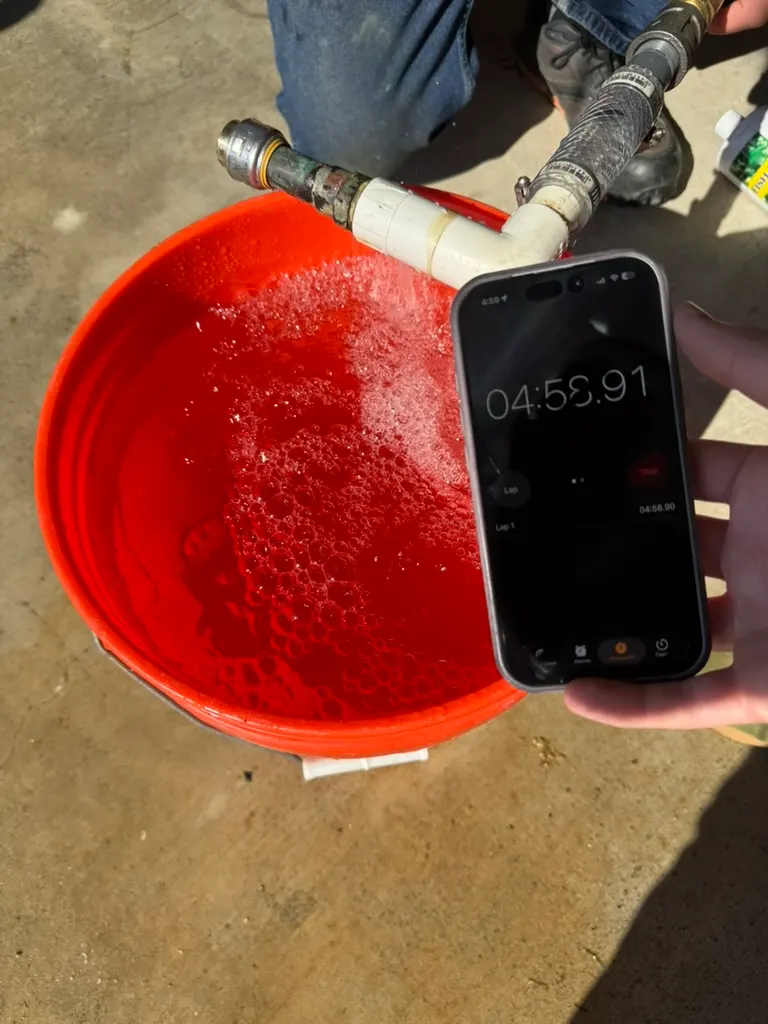
We used a controlled bucket test at a hose connection downstream of the pressure regulator.
Five gallons were collected in approximately five minutes.
5 gallons ÷ 5 minutes = 1 gallon per minute
This measurement was taken at regulated household pressure. The failed main-line section was on the upstream side of the pressure regulator and was exposed to higher supply pressure. For that reason, one gallon per minute is a conservative baseline for the calculation, not an attempt to inflate the result.
From one minute to two months
At the measured baseline:
1 gallon/minute × 60 minutes/hour × 24 hours/day = 1,440 gallons/day
Because the failure was on the main water line, the leak was not limited to periods when a faucet or appliance was operating. It could run continuously.
Using 60 days as a straightforward estimate of the owner-reported two-month timeframe:
1,440 gallons/day × 60 days = 86,400 gallons
That is approximately 86,400 gallons of water lost without a visible puddle or wet area appearing above the failure.
An illustrative water-cost range
The exact charge depends on the property’s utility rate, billing tiers, sewer-charge rules, fees, and the dates included on the bill. Until the actual bill or confirmed utility rate is available, the most responsible approach is to show the arithmetic as an illustrative range rather than claim a precise dollar amount.
At $4.00 per 1,000 gallons:
86.4 × $4.00 = $345.60
At $5.00 per 1,000 gallons:
86.4 × $5.00 = $432.00
At $7.00 per 1,000 gallons:
86.4 × $7.00 = $604.80
Using that general range, the estimated water charge associated with 86,400 gallons would be approximately $346 to $605. That estimate addresses water volume only. It does not assign a dollar value to possible soil movement, erosion, foundation concerns, unnecessary concrete demolition, restoration, or other property effects that were not measured in this case.
Why locating comes before opening
The most important result was not the calculation. It was avoiding destructive work in the wrong location.
Had the garage-floor assumption been treated as a diagnosis, the owner could have paid for major interior demolition and still had an active leak outside. Precise leak locating changed the repair from a broad search into a targeted excavation.
This is why Speed King’s approach is simple: locate first, then open only what the evidence supports.
Case Photos & Videos